

Mastering the Inductive Sermon Format
How good are jokes when the joke teller delivers the punchline at the start? That's what a preacher does when he turns the traditional sermon development around and uses an inductive sermon format.
Good jokes come with the surprise of the punchline at the end. That's what makes a joke funny. Sermons can have a similar impact on hearers when the preacher doesn't reveal the main idea until the end. He builds suspense throughout the message like a good storyteller or joke teller. Then the ending surprises us and makes a bigger impact. We call that an Inductive sermon format or outline.
We will compare the difference between the traditional deductive sermon formation and this exciting inductive sermon format. To understand the difference between an Inductive Sermon Outline and the more traditional Deductive Sermon Outline, we'll use Proverbs 3:5-6, which we examined in the previous installment of the 10 Steps of Creative Sermon Prep in the Digital World using Logos,
After a preacher selects a passage, studies it, and determines a Big Idea, he will want to take the next step in Sermon Preparation, known as Outlining a Creative Sermon. The outline involves more than just a simple three-point outline with sub-points. Our approach to preaching focuses on a single Big Idea in a passage. We can design the sermon using either an Inductive Sermon format or a traditional Deductive Sermon Outline.
Deductive Sermon Outlines
In an expository sermon, preachers should not only derive their message from the text, but they should also base their sermon structure on it.
Haddon Robinson presented several potential expository sermon outlines in his classic text, Biblical Preaching: The Development and Delivery of Expository, focusing on the distinction between deductive and inductive development. Here's a typical Deductive Sermon Outline:
Introduction
Grab the attention of the audience in the first minute.
Create a need for the sermon communicating the Fallen Condition Focus (Bryan Chapell, Christ-Centered Preaching: Redeeming the Expository Sermon). The FCF = the reason listeners will WANT to listen to the message.
Transition to the text (background, explanation of any details that we need to understand about the text, and sometimes more).
The Big Idea - the statement of the thesis at the beginning of the passage indicates a deductive approach.
Body of the Sermon
Developing the thesis or Big Idea by explaining sermon points or movements.
Developing the thesis or Big Idea by illustrating sermon points or movements.
Developing the thesis or Big Idea by proving sermon points or movements.
Developing the thesis or Big Idea by applying sermon points or movements.
Conclusion
Summarize the message. If possible use a story to visualize the sermon that also summarizes the main idea and the sub-points.
Visualization shows what the Big Idea looks like when a person lives what you're teaching or preaching.
Offer a concrete Appeal that makes it clear to listeners what they can do to apply the Big Idea in their own lives.
We identify an argument as deductive when we state the Big Idea at the beginning and then develop it through the body of the sermon. We end with an appeal based on that Big Idea during the conclusion. That's a classic Deductive Sermon Outline (see the left most part of the diagram below).
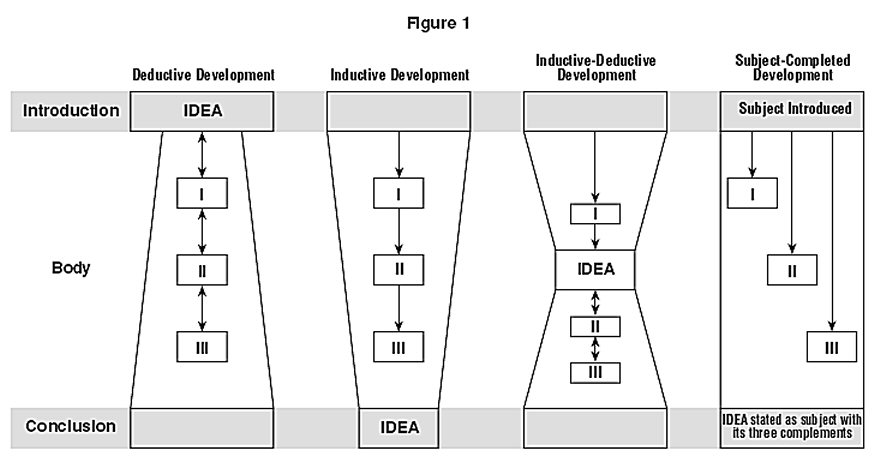
Deductive Sermon Development versus Inductive Sermon Development.
From Haddon Robinson's
Biblical Preaching
(p. 117)
An Example of a Deductive Sermon Outline
Let's take a look at one of my favorite passages.
5) Trust in the LORD with all your heart,
And lean not on your own understanding;
6) In all your ways acknowledge Him,
And He shall direct your paths. (Proverbs 3:5-6, NKJV)
A deductive development would begin with a possible Big Idea for this passage as follows:
If you trust God in everything, he will guide you through life's obstacles.
We get the Big Idea stated at the beginning of the sermon. Using the traditional Deductive Sermon Outline given above, we might begin with a story that shows how someone fails to trust the Lord and how it harms them. Then state the Big Idea. The body of the sermon would then explain, illustrate, prove, and apply the concept of the Big Idea. In the conclusion, we'd use another illustration that both summarizes the sermon and illustrates how a person can live the truth. Finally, offer some examples of trusting the Lord instead of leaning on your own understanding, offering an appeal.
Other outline forms include the following:
Deductive Outlines…
Explaining an Idea - state an idea and then explain the text meant by this idea.
Proving an Idea - state the idea and then spend the rest of the time proving that it's true.
Applying an Idea - state the idea and then apply it in the lives of the hearers.
Inductive/Deductive Outlines (starts inductive by offering details and then stating the main idea midway through)…
Lists of Parts of the Idea - Proverbs 3:5-6 is an example of this.
State the idea in the middle of the Body of the sermon. The first half leads up to the Big Idea, and the second half talks about the main idea.
Inductive Sermon Outlines
Beginning preachers and advanced preachers alike struggle with the Inductive Sermon Format in sermon design. That's because we don't often hear inductive sermons in evangelical churches. Since the Inductive Sermon Outline places the payoff at the end, it may seem more engaging and will keep the audience's attention.
How would we approach Proverbs 3:5-6 in an Inductive Sermon Outline? Since the main idea originates from the last line of verse 6, we will introduce it at the end of the outline. Instead, we would begin with the parts that lead to the whole. A preacher can then inductively develop the message using the first three lines in the passage that all lead to God making our paths straight.
5) Trust in the LORD with all your heart,
And lean not on your own understanding;
6) In all your ways acknowledge Him,
And He shall direct your paths. (Proverbs 3:5-6, NKJV)
The outline would then look like this...
What does it mean to trust in the Lord with all your heart?
What happens if we instead lean on our own understanding?
What does it mean to acknowledge God in all our ways?
Big Idea: If we will trust God in all things by acknowledging Him, then he will make our paths straight.
We would then go back and state these movements in a way that's more creative and interesting, but the structure of the sermon guides us to start with the concrete parts leading to the general abstract truth that gives us the Big Idea in the fourth point above.
Other Inductive Sermon Outline Examples
A story takes an inductive approach. Jesus' parables all give us the main idea at the end. Narrative stories seldom state the Big Idea explicitly. You have to read the whole story, and then you'll often see the thesis of the story in the climax.

The Parable of the Prodigal Son is by nature an Inductive Sermon Format because the messages comes at the conclusion.
The well-known parable of the Prodigal Son offers two climaxes. The first comes when the younger son returns home. How does his father welcome him? However, the first half of the story sets up the real message that is revealed in the climax of the second part. The father goes to the older son and tells him that what he has always had has been at the older son's disposal. The message then focuses on our response to God's grace when offered to someone who clearly doesn't deserve it.
The outline will look simple. Read the story and then explain details, sometimes illustrating how they might show up in modern examples. Then at the conclusion of the story, share the principal we learn from the story. Now, we conclude the message with an appeal and application.
A story takes on an inductive approach when the moral or the lesson comes at the end of the story. Jesus preached Inductively when he used parables. Jesus didn't long to create agricultural genius. He hoped to develop fruit-bearing believers. So he told a story about sewing seeds in four different kinds of soil. The lesson came after he told the story. Make sure to accept the truth of the Gospel in such a way that it grows and flourishes in your life.
Benefits of the Inductive Sermon Format
The inductive sermon holds the Big Idea of the text until the end. You create anticipation for the point the sermon makes. It grabs attention until the end, provided it is handled well.
When I approach Proverbs 3:5-6 deductively, it states the truth at the beginning, and people might zone out unless my illustrations or catchy phrasing grab attention. However, using an inductive approach draws people in by going on a journey together. We could consider placing our trust in various things, and the consequences of failing to trust God "with all your heart". Each example of poorly applied trust will hold attention. Then we find a way to state the main idea at the end, which gives a payoff. People feel a resolution that's not there until the preacher brings them to that point, leading up to it.
The inductive sermon format can benefit preachers and make sermons more engaging, but creating this kind of outlines will challenge beginning preachers. Use it carefully, but do consider using it.
Using Logos Workflows to Create an Inductive Sermon Outline
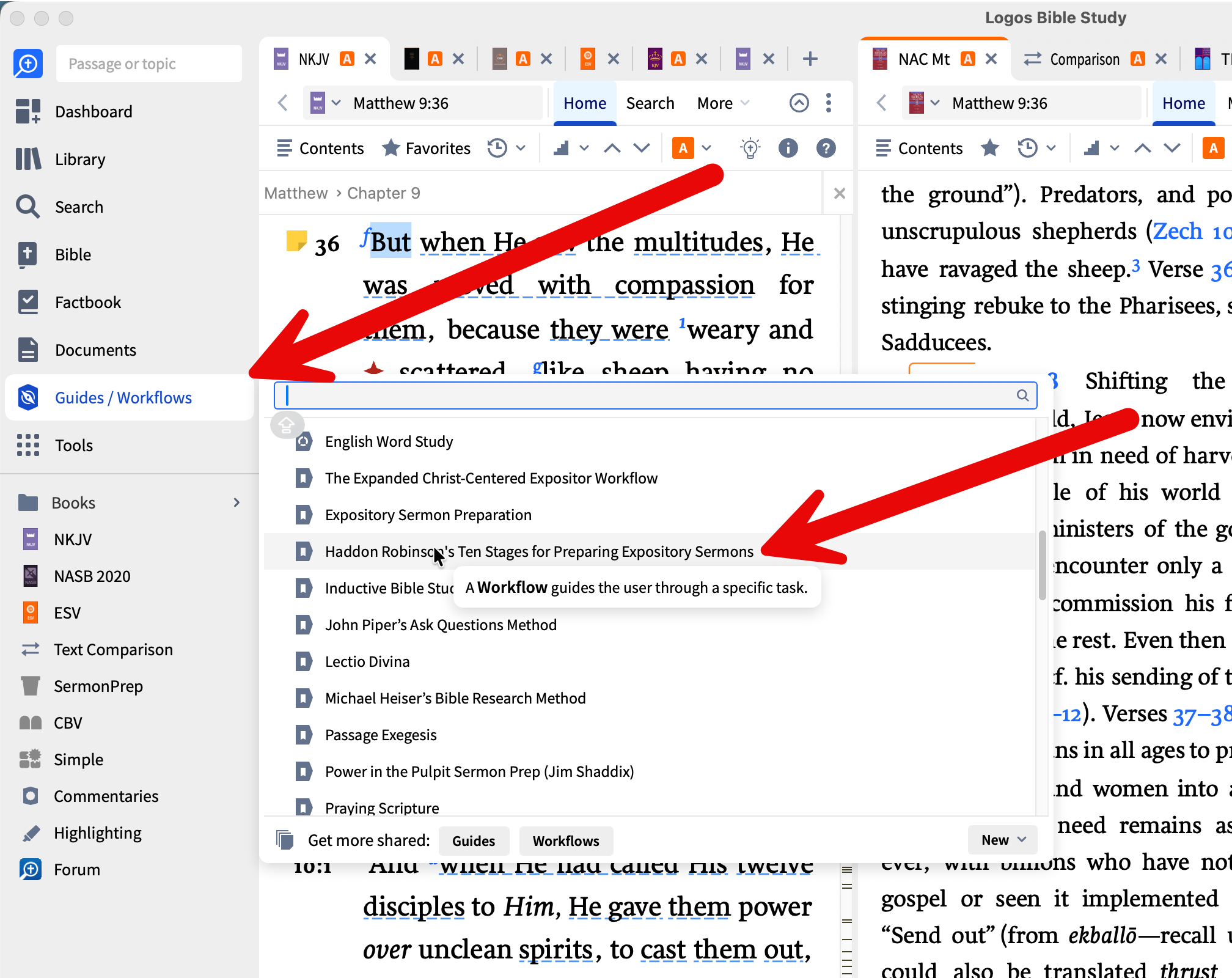
Use Logos Workflows to create a sermon using Haddon Robinson's method.
Logos Bible software will help you create a Habbon-Robinson-style inductive sermon using the Logos Workflows feature. To do that, open Logos and click on the Guides/Workflows menu. Go to the Workflows section and find the Workflow labeled "Haddon Robinson's Ten Stages for Preparing Expository Sermons".